
Importing from China to Mexico involves five main stages: finding the right supplier, negotiating terms, managing production and quality, coordinating international logistics, and carrying out customs clearance in Mexico. With a clear process and the right support, it is a profitable and repeatable operation.

Why import from China to Mexico?
China remains the world’s leading manufacturing supplier. For Mexican companies looking for textiles, consumer goods, electronics, accessories, or wholesale distribution merchandise, importing directly from China allows for significant cost reductions compared to buying from local intermediaries.
The challenge is not finding products — it is correctly managing the importation process so that the goods arrive on time, in the agreed conditions, and without customs problems.
Step 1: Identify and verify your supplier in China
The first step is finding a reliable supplier. Platforms like Alibaba, Made-in-China, or Global Sources are the most common starting points, but verifying the supplier is just as important as finding them.
Always request a sample before placing a volume order. Verify that the company has real production capacity, export history, and willingness to sign a clear contract with product specifications.
Working with an intermediary with a presence in China — such as IMPORTEX GROUP — reduces risk: someone at the origin can visit facilities, physically review samples, and negotiate directly in the supplier’s language.
Step 2: Negotiate terms and formalize the order
Once the supplier is confirmed, clearly define the order terms:
– Unit price and total price
– Agreed Incoterm (FOB, CIF, EXW — each defines who pays what part of the freight)
– Production time and estimated shipment date
– Payment terms (deposit + balance against documents is the most common)
– Detailed product specifications: materials, measurements, colors, packaging, labeling
An international sales contract, even if simple, protects both parties and is a reference in case of disputes.
Step 3: Supervise production and verify quality
During production, active tracking makes the difference. The most common problems — incorrect quantities, different materials, poor packaging — are detected during manufacturing, not upon receiving the goods in Mexico.
A pre-shipment inspection is the key moment: verifying the finished product in the supplier’s warehouse before authorizing the shipment. This includes a review of units, general condition, labeling, and packaging.
[IMAGE: inspector checking goods in a warehouse in China]
Step 4: Coordinate international logistics
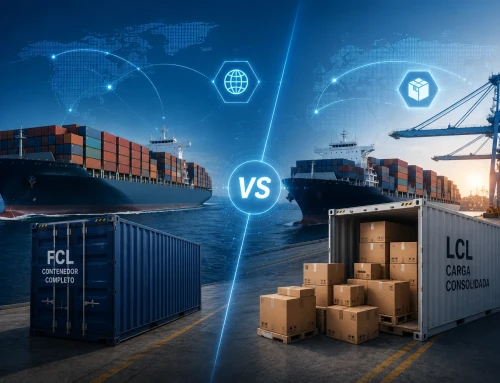
Once the shipping method is defined — sea FCL (full container), LCL (consolidated cargo), or air — the shipment and transport documents are coordinated:
– Bill of Lading (BL) for sea shipments
– Air Waybill (AWB) for air shipments
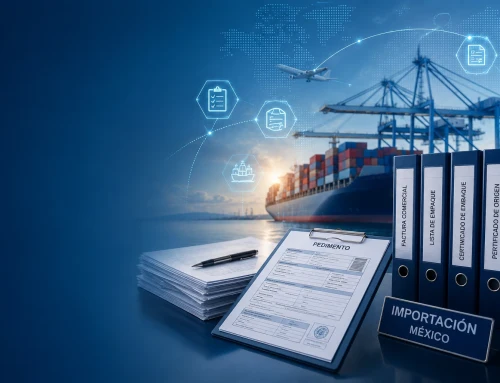
– Commercial invoice and packing list from the supplier
Tracking the shipment during international transit allows anticipating delays and having documentation ready before arrival in Mexico.
Step 5: Customs clearance in Mexico
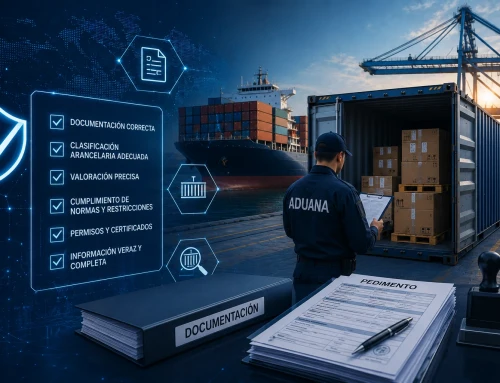
Upon the goods’ arrival at a port or airport in Mexico, a certified customs broker manages the clearance. For the process to be fast and without detentions, the documentation must be complete and correct prior to arrival:
– Commercial invoice with the correct declared value
– Detailed packing list
– BL or Air Waybill
– Special permits if the product requires them (COFEPRIS, SENASICA, NOM standards)
Once the goods are released from customs, the transfer to the final destination in Mexico is coordinated.
How long does it take to import from China to Mexico?
The total time depends on the shipping method and efficiency at each stage:
– Production: 15 to 45 days (depending on volume and complexity)
– Sea transit: 25 to 35 days from Chinese ports to Manzanillo or Lázaro Cárdenas
– Air transit: 3 to 7 days
– Customs clearance in Mexico: 1 to 5 business days with complete documentation
In total, a sea importation can take between 60 and 90 days from the start of the order to delivery in Mexico.
Frequently asked questions about importing from China to Mexico
Do I need to be a company to import from China to Mexico?
Yes. To import commercially in Mexico, it is required to be registered as a legal entity or a physical person with business activity before the SAT, with an active RFC (Tax ID) and in the import regime. A certified customs broker manages the import declaration (pedimento).
How much is paid in taxes when importing from China?
The main taxes are VAT (IVA) (16%) and the General Import Tax (IGI), whose rate varies according to the product’s tariff classification. Some products may also be subject to countervailing duties. The customs broker calculates the exact amount based on the value of the goods.
Which is better, FCL or LCL shipping from China?
FCL (full container) is advisable when the volume exceeds approximately 15 cubic meters. LCL (consolidated cargo) is more economical for smaller volumes. The decision depends on the volume, type of goods, and urgency of delivery.
Can you import from China without a customs broker?
No. In Mexico, the customs clearance of commercial imports mandatorily requires a customs broker certified by the SAT.
At IMPORTEX GROUP, we coordinate the entire importation process from China: suppliers, quality, logistics, and customs. Contact us for your next operation.