Here is the translated code with all tags and structures left completely intact:
“`text
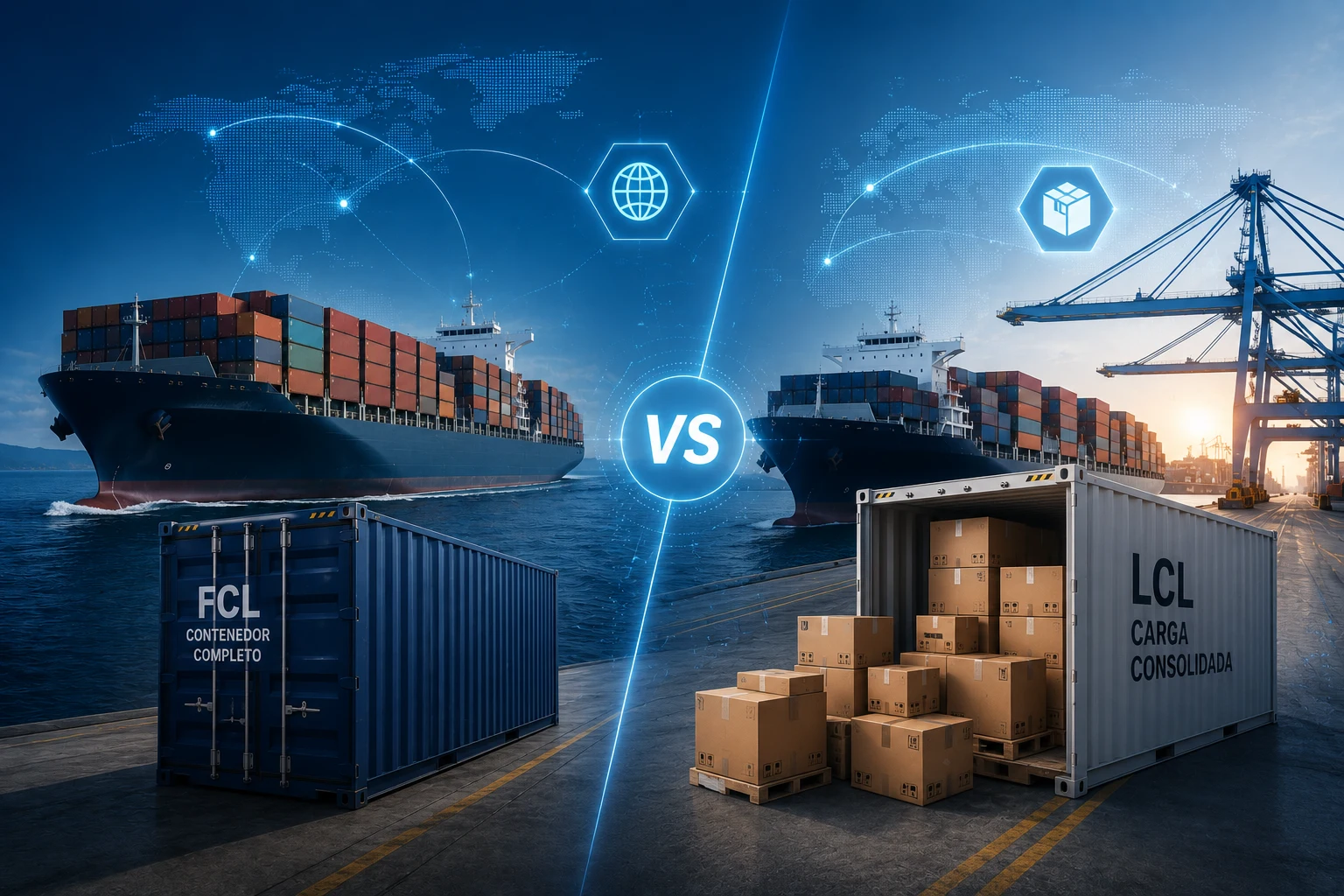
FCL (Full Container Load) is a full container exclusive to your cargo; LCL (Less than Container Load) is consolidated cargo where you share the container with other importers. FCL is advisable from 15 to 20 cubic meters of goods; LCL is more economical for smaller volumes.
What is FCL and what is LCL?
When you import goods by sea from China or other Asian markets, you have two main freight options:
FCL — Full Container Load
Your goods occupy a full container, either 20 feet (approximately 25 cubic meters of capacity) or 40 feet (approximately 55 cubic meters). The container is exclusively yours from the supplier’s warehouse to the port of destination.
LCL — Less than Container Load
Your goods are consolidated with the cargo of other importers in the same container. You only pay for the space your cargo occupies, measured in cubic meters (CBM) or tons, whichever is greater.
When is FCL advisable?
FCL is the right choice when:
– Your volume exceeds 15 CBM (cubic meters) per shipment
– Your goods are delicate or require special temperature or handling conditions
– You want to reduce the risk of damage from mixing with other cargo
– You need greater predictability in transit times
– Cost per imported unit is your priority
From a certain volume, the cost of a full container becomes more economical per cubic meter than the LCL rate. Furthermore, since there is no cargo consolidation or deconsolidation, transit times are usually more predictable.
FCL vs LCL Comparison
Criterion — FCL — LCL
Recommended minimum volume — more than 15 CBM — less than 15 CBM
Cost per CBM — lower at higher volume — higher per CBM
Risk of damage — low (exclusive cargo) — moderate (multiple handling)
Transit time — predictable — variable (depends on consolidation)
Volume flexibility — low (pays for full container) — high (pays only for what you ship)
Documentation — straightforward — can be more complex (co-loading)
Ideal for — importers with established volume — new importers or those with variable volumes
What about air shipping?
Air freight does not use FCL or LCL — it is quoted per kilogram of actual weight or volumetric weight (whichever is greater). It is significantly more expensive than sea freight, but transit times are reduced to 3–7 days. It is advisable for urgent, high-value, and low-volume goods, or when the freight cost is marginal compared to the product’s value.
Frequently asked questions about FCL and LCL
Can I mix products from different suppliers in an FCL?
Yes, as long as the importer is the same. You can consolidate orders from several suppliers into one FCL container, although this requires additional logistical coordination so that all goods are ready at the same time at the same consolidation point.
How long does an LCL shipment take from China to Mexico vs FCL?
A sea FCL from southern Chinese ports to Manzanillo takes approximately 25 to 30 days. An LCL can take 30 to 40 days due to consolidation and deconsolidation times. Times vary depending on the port of origin and destination.
How is the CBM volume of my goods calculated?
CBM = length (m) × width (m) × height (m) per box, multiplied by the number of boxes. If the result is less than your actual weight in tons, you are charged by weight; if it is greater, you are charged by volume. The shipping line always applies the greater of the two.
At IMPORTEX GROUP, we advise you on the most convenient shipping method for each operation based on your volume, type of goods, and budget. Contact us before your next order.
“`